
For importers and distributors building a bathroom fixture range, faucets are among the most specification-sensitive categories in the catalogue. A faucet that suits one market’s plumbing conventions, vanity formats, and price expectations may sit on the shelf in another. This guide outlines the practical factors B2B buyers should weigh when sourcing bathroom faucets, from installation format and handle configuration to finish durability and market demand.
Start with Installation Format and Deck Layout
The first decision in any bathroom faucet range is the installation format, because it determines which vanities and sinks the product can serve. Buyers should confirm the number of faucet holes and the spread between them before committing to a mould or a container load. As Consumer Reports notes in its faucet buying guide, single-handle faucets are generally easier to use and install and take up less space than two-handle models, though buyers should check the distance to the backsplash or window ledge, since the handle’s rotation may hit whatever sits behind it. That clearance point matters for compact vanities and for pre-fabricated vanity tops where holes are already cut.
Handle configuration also shapes the range. Single-handle designs suit volume-driven retail assortments and smaller bathrooms, while two-handle and widespread formats appeal to renovation and hospitality projects where a more traditional look is specified. Distributors serving both channels often carry a mix rather than a single format. For buyers who also supply kitchen categories, the same logic applies across the range: JOMOLA’s pull out kitchen faucet, model YF-05014-CP, for example, is built from brass and zinc with a ceramic cartridge valve, supports hot and cold water supply, and uses a 3/8″ female compression hose connection — details that matter when matching a faucet to a market’s plumbing standards.
Match Materials, Finishes, and Demand to Your Market
Material and finish choices drive both perceived value and after-sales risk. Chrome remains a mainstream default for bathroom faucets because it is durable and easy to coordinate, while brushed and satin finishes are increasingly requested in premium residential and hospitality projects. Buyers should ask suppliers for the base material behind the finish — brass and zinc constructions are common in mid-market faucets — and confirm the valve type, since ceramic cartridges are widely specified for everyday reliability.
Market context supports a steady outlook. Research cited by BusinessWire projects the bathroom fixtures and fittings segment to record a 4.5% CAGR, reaching US$53.1 billion by the end of its analysis period, while the broader plumbing fixtures and fittings market was valued at $123.37 billion in 2026 and is forecast to reach $164.78 billion by 2030. A separate forecast from Future Market Insights anticipates 4.5% CAGR between 2026 and 2036 for luxury plumbing fixtures, with China forecast to grow at 6.1% and India at 5.6%. On the demand side, the National Kitchen & Bath Association projects the U.S. kitchen-and-bath industry will reach about $228 billion in 2026, with repair-and-remodel spending expected to grow 2.9 percent, according to The Hardware Connection. For distributors, this points to replacement and remodel demand as a stable base, with premium finishes and water-efficient technologies as the value-added tier.
Finish coordination is worth noting in assortment planning. Industry trend reporting highlights mixed metals and coordinated finishes as a strong 2026 design direction, with designers intentionally pairing complementary metals across fixtures and accessories rather than matching every finish exactly. A bathroom faucet range that offers chrome alongside brushed and satin options gives retailers room to merchandise to that trend.
Build the Range Around Real Product Families
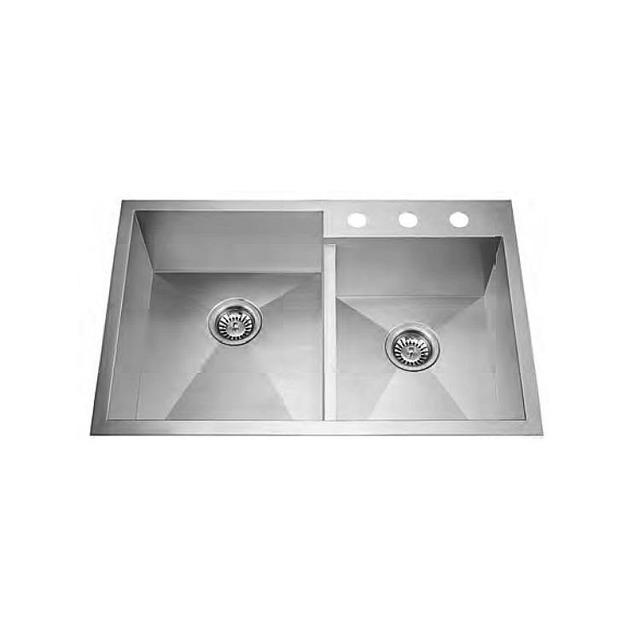
Bathroom faucets rarely sell alone. Distributors who bundle faucets with sinks, drains, and shower fittings can offer retailers a more complete programme and reduce the number of suppliers a buyer manages. JOMOLA’s catalogue illustrates how the categories connect: the YYD-993-5 stainless steel floor drain is offered in 5 in and 6 in catalogue sizes in SUS 304 / 201 material with 1.2 mm thickness and a polished finish, while the concealed floor drain (YYD-P2_Concealed) uses SUS 304 stainless steel with 1.2 mm thickness and a satin finish for residential and commercial drainage applications. On the sink side, the KUD3218 pressed stainless steel sink pairs a double bowl layout with 304 stainless steel in a 32 1/8″ x 17 3/4″ undermount format, built with 1.2 mm thickness and a 9″ deep main bowl alongside a 6″ secondary bowl. For buyers assembling a bathroom programme, matching drain and faucet finishes across a single order simplifies retail presentation.
Sourcing conversations should also cover packaging, carton configurations, and mixed-container flexibility, since these determine landed cost as much as unit price does. Buyers should request finish samples and confirm the valve and connection specifications in writing before placing volume orders.
Recent Company News
JOMOLA’s recent blog coverage addresses specification questions relevant to B2B buyers, including single bowl versus double bowl sink selection for retail markets, commercial sink specification for foodservice projects, smart kitchen faucet demand in Europe and the USA, commercial kitchen sink maintenance practices, and fireclay versus quartz sink material selection. These articles are available on the company’s website.
Conclusion
A bathroom faucet range succeeds when installation format, handle configuration, material and finish, and companion products are planned together rather than item by item. Importers and distributors should verify deck layout and clearance, confirm valve and connection specifications, and build assortments that reflect the replacement and remodel demand driving the category. Pairing faucets with sinks and drains from a single manufacturing partner reduces supplier complexity and supports more coherent retail merchandising.
About JOMOLA
JOMOLA is a Chinese OEM/ODM manufacturer of kitchen sinks, kitchen faucets, bathroom sinks, bathroom faucets, shower faucets, and floor drains. The company supplies B2B buyers including importers, wholesalers, and project purchasers, with product lines spanning punching and handmade sinks, brass and zinc faucets, and SUS 304 / 201 stainless steel floor drains.
Sources
- https://www.kohler.com/en/inspiration/buying-guides/bathroom-faucet-buying-guide
- https://www.ruvati.com/kitchen-faucet-buying-guide
- https://www.consumerreports.org/home-garden/faucets/buying-guide
- https://www.youtube.com/watch?v=fyDlMeYT-NQ
- https://www.badeloft.com/blogs/guide/choose-bathroom-faucet
- https://www.businesswire.com/news/home/20220426006049/en/Global-Plumbing-Fittings-and-Fixtures-Industry-to-2026—New-Constructions-Offer-Significant-Opportunities—ResearchAndMarkets.com
- https://www.futuremarketinsights.com/reports/luxury-plumbing-fixtures-market
- https://thehardwareconnection.com/bathroom-remodeling-drives-demand
- https://inlandbath.com/blog/kitchen-and-bathroom-design-trends-2026-what-is-in-what-is-out-and-tri-cities-investment-tips
- https://finance.yahoo.com/news/plumbing-fixtures-fittings-market-outlook-154900650.html
- https://www.grandviewresearch.com/industry-analysis/kitchen-sinks-market
- https://thesinkboutique.com/blogs/news/kitchen-design-trends-sinks-faucets
- https://www.gminsights.com/industry-analysis/kitchen-sinks-market
- https://finance.yahoo.com/news/household-kitchen-sinks-market-forecast-164100288.html
- https://www.simpolo.com/blog/kitchen-sink-designs-modern-homes