
For importers, distributors, and project buyers building a kitchen sink range, understanding how an OEM sink moves from concept to container is essential for evaluating suppliers, setting realistic timelines, and controlling quality. The OEM kitchen sink manufacturing process combines a structured development sequence with a series of physical production stages — shearing, forming, welding, finishing, and inspection. This guide walks through both, using real industry practice and JOMOLA’s own product range as reference points.
From Concept to Production: The OEM Development Sequence
According to industry guidance on OEM sink development, the process typically follows eight steps: defining market needs, translating them into product specifications, evaluating technical feasibility, prototyping, product validation, cost and production planning, pilot production, and mass production with continuous improvement. For buyers, the first two steps matter most — a clear specification brief (bowl configuration, overall dimensions, material grade, finish, and mounting style) determines everything downstream.
Technical feasibility review then confirms whether the design can be formed economically at the required volume. Prototyping and validation follow, allowing buyers to test samples before committing to tooling and production planning. Pilot production serves as the final checkpoint before mass production begins. This structured approach is why experienced buyers treat OEM development as a project with defined milestones rather than a simple purchase order.
The Physical Manufacturing Stages
Once specifications are locked, production moves through a well-established sequence. It begins with raw material preparation: selecting stainless steel sheets of the required grade and thickness. The sheet is then sheared to size before forming. For standardized sinks — such as single or double basin models — deep drawing and hydraulic stretching with precision molds achieve efficient forming, with industry sources citing tolerances of around ±0.5 mm and low waste rates at high volume. This pressed approach suits large-scale standardized production.
Handmade sinks follow a different path, with panels cut, bent, and welded rather than drawn from a single sheet. After shaping and welding, trimming and edge finishing refine the rim and drain opening; automated factories use laser cutting for precise, fast trimming. Surface finishing — brushing, polishing, or specialty finishes — comes next, followed by quality inspection and packing.
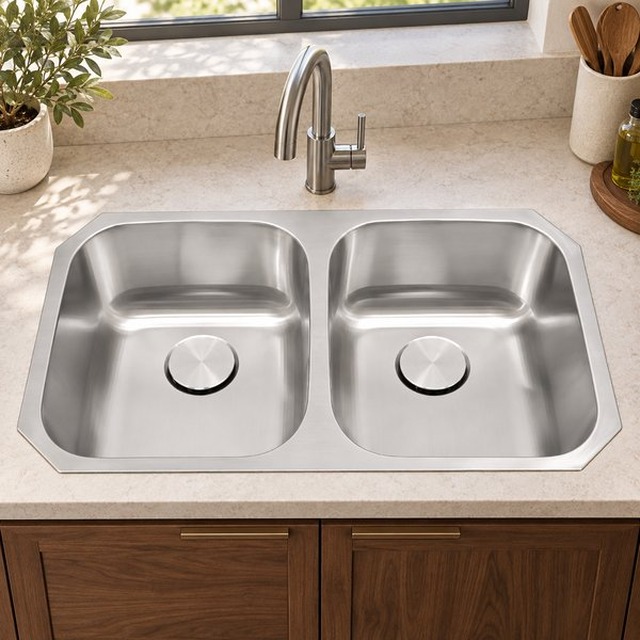
JOMOLA’s catalogue reflects both production routes. The JOMOLA KA3218A punching stainless steel sink is a double bowl kitchen sink with a 32 x 18 in catalogue size, built for residential and commercial installations. The JOMOLA KA7645A punching stainless steel sink combines a 760 × 450 mm catalogue size with an integrated drainboard. The JOMOLA KUS1816 pressed stainless steel sink is an undermount single bowl model in 304 stainless steel with 1.2 mm thickness and an 18″ x 16″ bowl, 8″ deep. At the handcrafted end, the JOMOLA JDMH-8356 handmade stainless steel sink is a topmount unit measuring 838 × 558 × 254 mm with a Rose Gold finish.
What Buyers Should Verify at Each Stage
Material grade and thickness are the first specification decisions, as JOMOLA’s own blog on kitchen sink safety and material standards notes — the material a sink is made from, its thickness, and its construction directly shape durability and compliance. Buyers should confirm the steel grade (201 versus 304), the gauge or millimeter thickness, and the finish consistency across production lots.
Forming method also affects the commercial case. Pressed sinks offer repeatability and scale; handmade sinks offer design flexibility and premium positioning. Finish durability deserves scrutiny too, particularly for colored finishes such as Rose Gold, where buyers should request samples that reflect real-world use. Finally, packaging and inspection protocols should be agreed before pilot production, not after.
The wider market context supports this disciplined approach. The global kitchen sink market was valued at USD 3.8 billion in 2025 and is projected to reach USD 4.1 billion in 2026, expanding at approximately 6.2% CAGR through 2035, with residential replacement activity the largest volume base. Industry forecasts cited by the National Kitchen & Bath Association project the U.S. kitchen-and-bath industry will reach about $228 billion in 2026. In the UK, the kitchen sinks market is estimated to grow at a 4.3% CAGR from 2026 to 2033, with growing interest in multifunctional designs. For OEM buyers, that demand rewards suppliers who can document each manufacturing step clearly.
Recent Company News
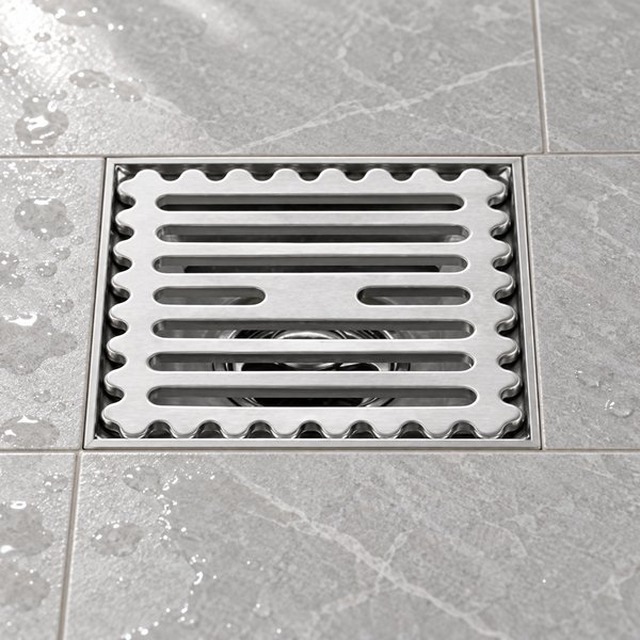
JOMOLA’s recent blog coverage addresses the specification questions buyers raise during OEM development. “Kitchen Sink Safety and Material Standards Explained” examines how material choice and thickness drive safety and durability. “Stainless Steel Sink vs Granite Sink: Key Differences Explained” helps buyers frame the first specification decision when building a kitchen sink range. “Floor Drain Types and Installation Requirements: A B2B Buyer’s Guide” and “Water Efficiency Requirements for Faucets in the EU: A B2B Sourcing Guide” extend the same specification-led approach to drainage and faucets. JOMOLA’s floor drain range includes the YYD-315A, a 100×100 mm stainless steel floor drain in 201 steel with 3 mm thickness and a brushed finish, and the YYD-2905, a 100×100 mm model with 9 mm thickness and a brushed finish.
Conclusion
The OEM kitchen sink manufacturing process is best understood as two linked sequences: a development path from market need to pilot production, and a physical production path from steel sheet to finished, packed sink. Buyers who specify material grade, thickness, forming method, and finish upfront — and who verify each stage against agreed standards — reduce risk and shorten time to market. JOMOLA’s combination of punching, pressed, and handmade stainless steel sinks gives buyers a practical starting point for matching production method to price point and market positioning.
About JOMOLA
JOMOLA is a Chinese OEM/ODM manufacturer of kitchen sinks, kitchen faucets, bathroom sinks, bathroom faucets, shower faucets, and floor drains. Its product range includes punching stainless steel sinks, pressed stainless steel sinks, handmade stainless steel sinks, and stainless steel floor drains, supported by specification-focused guidance for importers, distributors, and project buyers.
Sources
- https://atlakitchens.com/oem-kitchen-sink-development-process-guide
- https://www.samsink.com/comm06/Stainless-Steel-Sink-Manufacturing-Process.htm
- https://www.scribd.com/presentation/431360338/Manufacturing-of-steel-sinks
- https://lordear.com/blogs/kitchen-sinks/the-craft-behind-stainless-steel-kitchen-sinks-how-they-re-made
- https://www.youtube.com/watch?v=hYjw1EMnSTM
- https://www.gminsights.com/industry-analysis/kitchen-sinks-market
- https://www.grandviewresearch.com/industry-analysis/kitchen-sinks-market
- https://thehardwareconnection.com/bathroom-remodeling-drives-demand