
For wholesalers, importers, and project buyers, stainless steel grade is one of the most consequential specification decisions in a kitchen sink program. It affects corrosion performance, formability, finish consistency, and — critically — whether the product you deliver matches the claim on the box. This guide explains what 304 stainless steel actually is, how it compares with 201 and 316, and how to align grade selection with the markets you serve.
What “304” Actually Means — and Why It Dominates Kitchen Sink Programs
304 stainless steel is commonly described as “18/8” stainless because its nominal composition is approximately 18% chromium and 8% nickel. Outokumpu characterizes 304 as a widely used grade that balances corrosion resistance, formability, and cost — which is precisely why it has become the default alloy for most kitchen sink programs worldwide.
The performance mechanism is straightforward. According to Harrington, the combination of roughly 18% chromium and 8% nickel creates an invisible “passive layer” on the steel surface that protects the underlying metal from oxidation. In humid climates and in kitchens exposed to water, acids, and cleaning agents daily, that passive layer is what separates a sink that performs for years from one that shows rust within months.
This matters for B2B buyers because grade mismatches are a commercial risk, not just a technical one. As one industry analysis puts it, the biggest risk is often not the grade itself — it is a mismatch between the material, the sales claim, and the use environment. A sink sold as 304 but produced from a lower grade, or a genuine 304 sink marketed into an application it was never specified for, both create warranty exposure and reputational damage for the brand on the label.
Grade and gauge are separate decisions and should be specified separately. Gauge describes steel thickness; 304 describes the alloy. Both 16-gauge and 18-gauge sinks can be made from 304 stainless steel, and for premium residential kitchen sinks, both gauges are considered excellent options. Thicker 16-gauge 304 is typically recommended for large single-bowl sinks, workstation sinks, heavy cookware use, and high-use kitchens — a useful rule of thumb when configuring a product range.
304 vs. 201 vs. 316: Matching Grade to Market
The three grades most commonly encountered in sink sourcing occupy distinct positions.
**201** contains very little nickel and higher manganese. In humid air and water, 201 oxidizes quickly — Harrington’s analysis of the Bangladesh market notes that locally sold “Grade 201” and “Grade 202” sinks rust rapidly under exactly those conditions. That said, 201 is not inherently unusable. A buyer’s guide from ghotensink recommends 201 for budget residential projects with short renovation cycles, indoor-only installation, and low moisture exposure — provided the grade is clearly disclosed to the end customer. The same guide recommends 304 for high-end residential, commercial kitchen, and marine or coastal markets, and for long-term rental or resale property where warranty exposure matters.
**304** is the workhorse grade for the broad middle and upper range of the market, and it is the grade JOMOLA specifies for its pressed stainless steel sink line. The JOMOLA KUS1519, for example, is an undermount single bowl pressed sink built from 304 stainless steel for lasting durability in residential and commercial kitchens, measuring 15″ x 18 1/2″ with an 8″ bowl depth.
**316** adds molybdenum for enhanced chloride resistance and is typically reserved for marine and highly corrosive environments. For most kitchen sink programs it is a premium niche rather than a volume specification.
A practical sourcing matrix therefore looks like this: 304 as the default for branded programs, commercial kitchens, and coastal markets; 201 as a clearly labeled budget option for dry, indoor, price-sensitive projects; 316 for specialized corrosive environments. The grade should always be documented on the spec sheet, the purchase order, and the retail packaging — because the mismatch risk runs in all three directions.
Specifying 304 Across a Full Sink and Fixture Program
Grade selection does not stop at the sink bowl. Buyers assembling a complete kitchen and bath package should apply the same discipline across the catalogue.
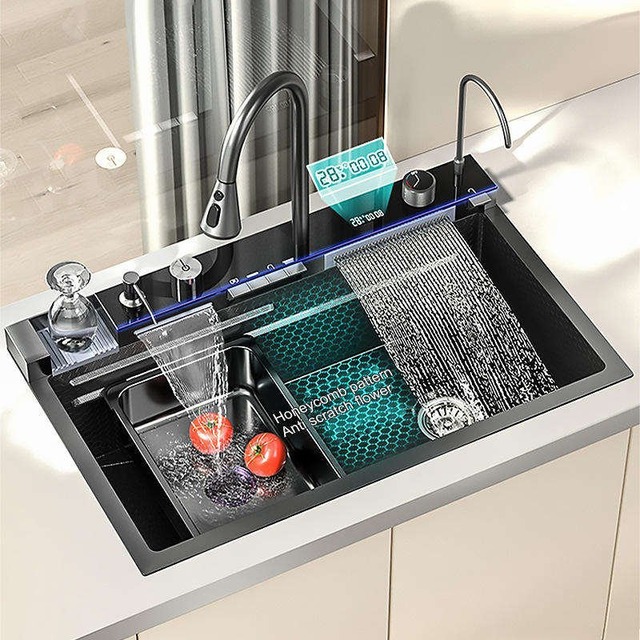
Within JOMOLA’s range, 304 appears in multiple construction methods. The JOMOLA JSH-7545 is an above-counter stainless steel single bowl workstation sink measuring 750×450×230mm, integrating multiple optional accessories for food preparation and cleanup. The JOMOLA KA12050S is a punching stainless steel sink at 1200 × 500 mm with an integrated drainboard that combines washing and drying space in one unit — a format well suited to foodservice and utility applications where 304’s corrosion resistance earns its cost.
Grade logic also extends to drainage products. The JOMOLA YYD-522-5 floor drain is a 150×150 mm unit built from 201 stainless steel with 6 mm thickness and a polished finish — an example of where a lower grade can be appropriate for a wet-area drain cover, provided the specification is transparent. Buyers should confirm that the grade stated for each SKU matches its intended exposure.
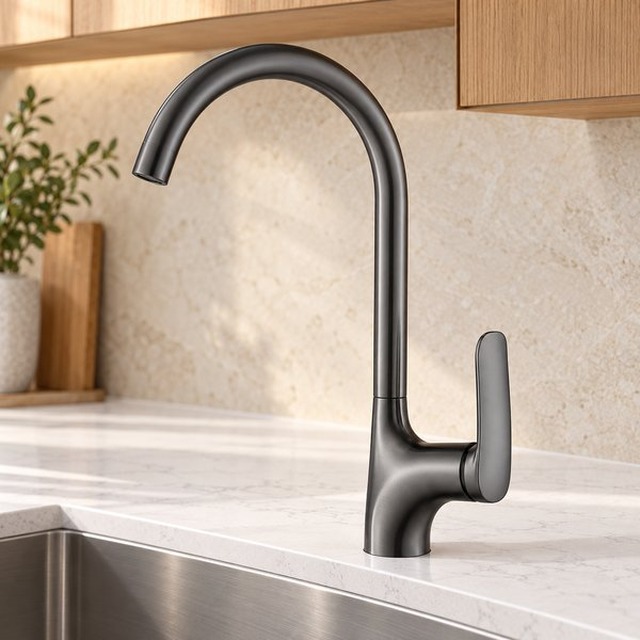
Finally, consider the finish and faucet pairing. JOMOLA’s kitchen faucet range includes the YF-05013-QH gunmetal brass faucet with ceramic cartridge and the YF-05025-LS pull-out faucet in brushed nickel with ceramic cartridge, built to cUPC standard. Finish consistency between sink and faucet is increasingly part of the specification conversation, and 304’s formability supports the brushed and polished finishes buyers expect in coordinated programs.
Market context supports disciplined sourcing. Grand View Research values the global kitchen sinks market at USD 3.9 billion in 2025, growing to USD 5.3 billion by 2033 at a 3.8% CAGR, with Asia Pacific holding a 47.1% revenue share in 2025. GMInsights similarly projects growth from USD 4.1 billion in 2026 to USD 7 billion by 2035 at roughly 6.2% CAGR, noting that material upgrading and multifunctional workstation formats are broadening value per installation. In a market where material upgrading is a stated growth driver, grade transparency becomes a competitive advantage rather than a compliance chore.
Recent Company News
JOMOLA publishes buying guidance for trade buyers through its blog, including “Stainless Steel Kitchen Sink Buying Guide for Wholesalers,” which covers key specification decisions such as gauge, finish, configuration, and supplier capability; “Undermount vs Drop-In Sink: Which Fits Your Market?”, which frames the mounting decision around countertop systems and installation requirements rather than a universal winner; and “How to Choose a Reliable Kitchen & Bathroom Fixtures OEM Manufacturer,” which addresses supplier selection for importers, wholesalers, and project buyers. The company has also published a Nano Black Hidden Sink OEM supplier feature.
Conclusion
For most kitchen sink programs, 304 is the correct default: its 18% chromium and 8% nickel content creates the passive layer that resists the moisture, acids, and cleaning agents of daily kitchen use. 201 has a legitimate place in clearly disclosed budget, indoor, low-moisture applications, while 316 remains a specialist choice. The real risk for B2B buyers is not choosing a grade — it is allowing a gap between the grade, the sales claim, and the use environment. Specify grade and gauge separately, document both on every PO, and match each SKU to its exposure. JOMOLA’s 304 pressed and workstation sinks, punching sinks with integrated drainboards, and coordinated faucet range give buyers a starting point for building a grade-consistent catalogue.
About JOMOLA
JOMOLA is a Chinese OEM/ODM manufacturer of kitchen sinks, kitchen faucets, bathroom sinks, bathroom faucets, shower faucets, and floor drains. The company supplies trade buyers through a product range that includes handmade sinks, punching sinks, kitchen faucets, and floor drains, and publishes sourcing guidance for importers, wholesalers, and project buyers.
Sources
- https://matrixsinks.com/201-vs-304-vs-316-stainless-steel-sinks
- https://harrington.com.co/why-grade-304-steel-sink-important
- https://cavalieriflooring.com/pages/blog/304-stainless-steel-kitchen-sinks
- https://ghotensink.com/blogs/news/304-vs-201-stainless-steel-sink
- https://www.grandviewresearch.com/industry-analysis/kitchen-sinks-market
- https://www.gminsights.com/industry-analysis/kitchen-sinks-market