
Specifying sinks for restaurants, hotel kitchens, and school canteens is one of the more demanding parts of a foodservice project. The quantity and variety of sinks required, combined with local code variations, make this a category where buyers cannot rely on guesswork. As Mise Designs notes in its commercial kitchen sink guidelines, installation requirements can vary by location, so following local rules — often with the help of a qualified restaurant consultant — is essential. For wholesalers, importers, distributors, and project buyers, the goal is to match durable, code-compliant products to each application without over- or under-specifying.
Matching Sink Types to Kitchen Functions
Commercial kitchens typically need more than one sink type. Hand sinks serve staff hygiene; prep sinks support food handling; dishwashing areas often rely on three-compartment setups. CKitchen.com reports that restaurant hand sinks are commonly installed at heights between 34 and 36 inches (86 to 91 centimeters) to support ergonomic comfort and accessibility guidelines. Three-compartment sinks, meanwhile, are central to the manual warewashing method: when used correctly, they help restaurants stay up to health code standards, and noncompliance can lead to fines or worse, per WebstaurantStore.
Material choice matters just as much. Most commercial kitchens use Type 304 stainless steel, which handles typical food-contact conditions well, while Type 316 adds molybdenum for better corrosion resistance in coastal locations or kitchens exposed to high chloride levels or aggressive cleaning chemicals, according to CKFCO’s commercial sink requirements guide. Stainless steel remains the dominant volume category in the broader kitchen sink market, which was valued at USD 3.8 billion in 2025 and is projected to grow at roughly 6.2% CAGR from 2026 to 2035, according to GM Insights — with foodservice expansion and material upgrading among the drivers.
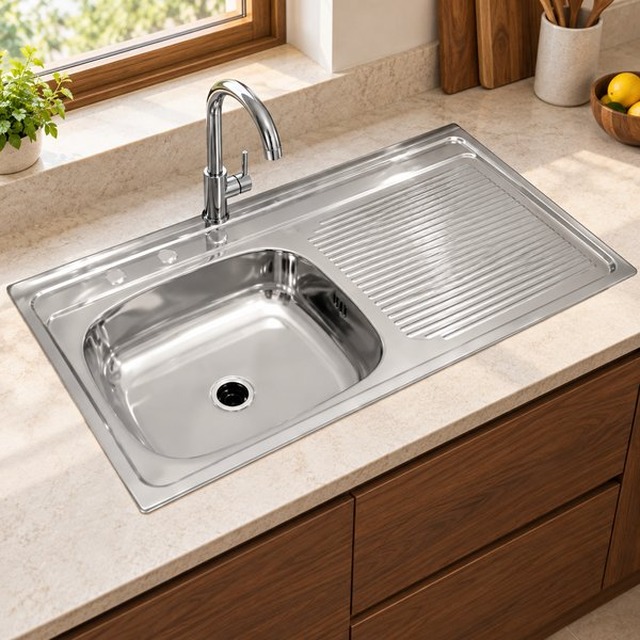
JOMOLA’s range covers several of these needs. The Punching Stainless Steel Sink KA10050E is built to a catalogue size of 1000 × 500 mm with an integrated drainboard, combining the strength of a pressed stainless steel sink with practical workspace. For operations that prefer handcrafted construction, the Handmade Stainless Steel Sink HUD3120-9 offers a double-bowl configuration in 304 stainless steel with a brushed finish, while the above-counter single-bowl model JSRH-8453 measures 840 × 530 × 254 mm (33 × 21 × 10″) with a brushed satin finish — a format suited to premium installations.
Avoiding Common Buying Mistakes
Price-only purchasing is one of the most frequent and costly errors. Sinonor Commercial Kitchen Equipment warns that cheaper sinks often use thinner stainless steel, lower-grade materials, or poor workmanship — savings that are quickly erased by replacement and downtime. Buyers should weigh material grade, steel thickness, and construction method against the duty cycle of the kitchen.
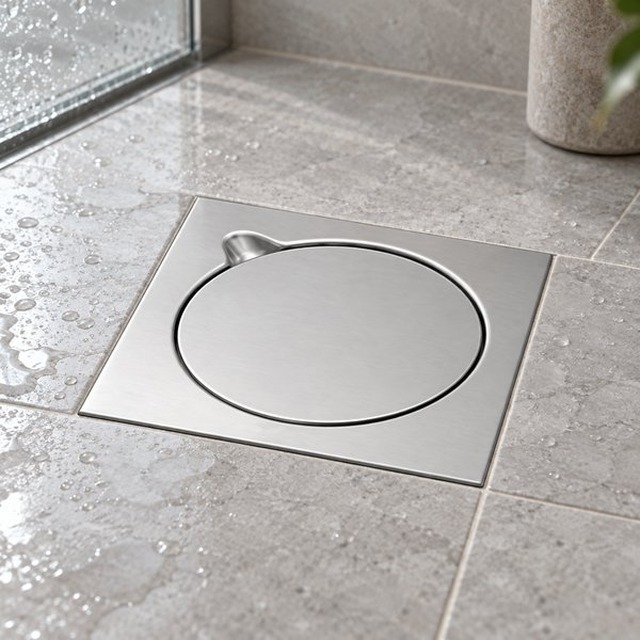
Drainage is another specification that is easy to overlook. Floor drains in commercial kitchens must handle grease, food residue, and frequent washdowns. JOMOLA’s Stainless Steel Floor Drain YYD-995-5 is available in 3.5 in, 5 in, and 6 in overall sizes, manufactured from SUS 304 / 201 stainless steel with 1.2 mm thickness and a polished finish. For compact applications, the YYD-02357 offers a 100 × 100 mm cover in 201 stainless steel with 2 mm thickness and a satin finish, while the YYD-_Triangular_Dual-Use model provides a 200 × 200 mm SUS 304 drain cover with a 0.8 mm base and 1.2 mm cover for demanding residential and commercial drainage.
Maintenance planning should also start at the specification stage. JOMOLA’s own guidance on commercial kitchen sink maintenance best practices for B2B buyers highlights that commercial sinks endure constant use, grease, food residue, and cleaning chemicals — factors that should shape both product selection and the after-sales advice buyers pass on to end users.
Recent Company News
JOMOLA continues to publish B2B-focused resources for the kitchen and bath trade. Recent blog topics include smart kitchen faucet demand in Europe and the USA, kitchen faucet market trends and what buyers look for in 2026, fireclay versus quartz sink material selection, and commercial kitchen sink maintenance best practices. The company also presents its bathroom faucet OEM supplier capabilities for wholesale and project buyers.
Conclusion
A commercial sink specification is only as good as its fit with local code, kitchen workflow, and daily duty cycle. Buyers who verify material grade, construction, dimensions, and drainage — rather than defaulting to the lowest quote — protect their clients from premature replacement and compliance problems. With stainless steel sinks, handcrafted options, and a range of floor drains in SUS 304 and 201, JOMOLA gives B2B buyers a practical starting point for restaurants, canteens, and other foodservice projects.
About JOMOLA
JOMOLA is a Chinese OEM/ODM manufacturer of kitchen sinks, kitchen faucets, bathroom sinks, bathroom faucets, shower faucets, and floor drains. The company serves wholesalers, importers, distributors, and project buyers with stainless steel sink and drain products, including punching sinks, handmade sinks, and floor drains in SUS 304 and 201 stainless steel.
Sources
- https://www.misedesigns.com/commercial-kitchen-sink-guidelines
- https://www.ckitchen.com/blog/2023/7/commercial-kitchen-hand-sink.html
- https://sinonorkitchen.com/7-commercial-sink-buying-mistakes-that-cost-restaurant-owners-money
- https://www.ckfco.com/feeds/blog/sink-requirements-commercial-kitchen
- https://www.webstaurantstore.com/article/620/three-compartment-sink-rules.html
- https://www.gminsights.com/industry-analysis/kitchen-sinks-market