
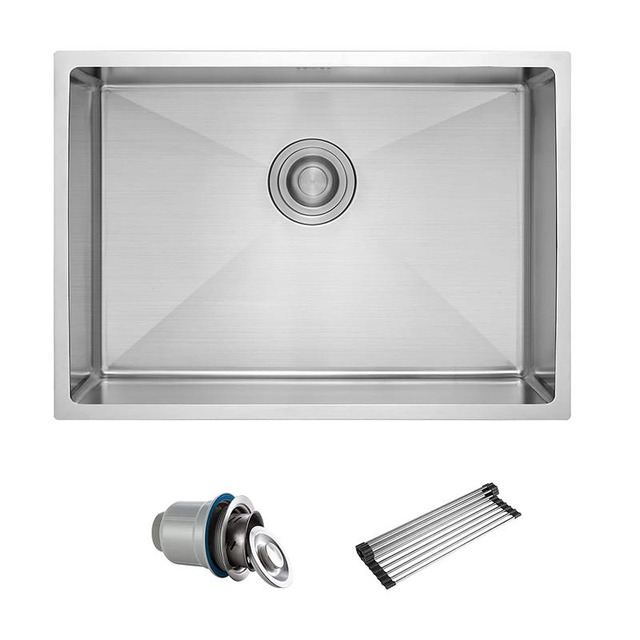
Importers sourcing kitchen sinks face a foundational decision that shapes pricing, positioning, and customer satisfaction: handmade versus machine-pressed construction. Both methods produce functional stainless steel sinks, but they differ in material behavior, design flexibility, and the market segments they serve. Understanding these differences helps wholesalers, distributors, and project buyers match product specifications to actual demand rather than defaulting to the lowest unit cost.
How the Two Manufacturing Methods Differ
Machine-pressed sinks are formed by stamping a flat sheet of stainless steel against a die under high pressure. This process is fast, highly repeatable, and well suited to high-volume production of standard rectangular bowls. Because the tooling is fixed, each model requires its own die, and design changes are costly. The result is a sink with uniform wall thickness and a shape defined entirely by the press.
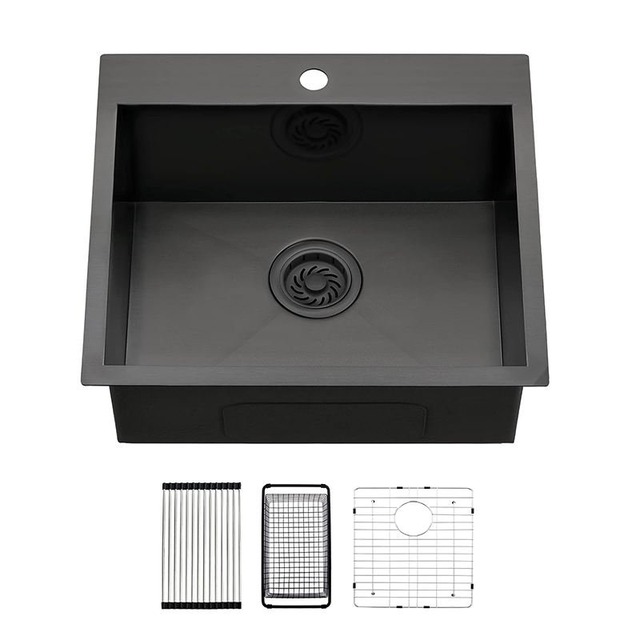
Handmade sinks are built differently. Individual steel panels are cut, bent, and welded together, then finished by hand. This approach allows for tighter corner radii, deeper bowls, and non-standard dimensions without new tooling. It also permits thicker gauge material to be formed without the cracking risk that can occur in deep-drawn pressing. The trade-off is more labor per unit and slightly greater variation between pieces.
For importers, the practical distinction is this: pressed sinks win on cost and consistency at scale; handmade sinks win on design freedom, material thickness, and premium positioning.
Sourcing Implications for Importers
The choice between the two directly affects your product catalog and margin structure. Pressed sinks are typically the right fit for entry-level and mid-market programs where customers prioritize price and standard sizes. As one industry source notes, for basic wholesale models, stable quality and consistent packing often matter more than complex customization.
Handmade sinks open different doors. If your customers ask for thicker material, modern designs, workstation functions, or custom sizes, handmade construction is often the only viable route. This aligns with broader market direction: the global kitchen sink market was valued at USD 3.8 billion in 2025 and is projected to reach USD 4.1 billion in 2026, with material upgrading and multifunctional workstation formats broadening the value captured per installation. Importers positioning toward the value end of the market should weigh handmade capacity accordingly.
Finishes also matter. PVD black and brushed surface treatments are increasingly requested, and 2026 design coverage points to confident use of mixed metals and coordinated finishes across sinks, faucets, and hardware. A handmade sink platform makes it easier to offer these finish variations across multiple sizes without retooling.
JOMOLA’s handmade range illustrates the flexibility. The JSH-5345 handmade stainless steel sink measures 530×450×230mm in a brushed or PVD black finish with topmount installation. The JSH-5346 topmount kitchen sink offers 530×460×230mm with a black finish and large basket. For larger applications, the JDH-7843-2 is available in 780×430×230mm or 820×450×230mm with brushed or PVD black treatment, while the JDH-7843 above-counter single bowl sink measures 780×430×220mm in brushed satin. Importers serving buyers who want granite composite alternatives can also consider the JDCQ-9650 undermount quartz kitchen sink at 600×480×200mm, available in Black, Ivory, Oatmeal, and White.
Matching Product Type to Market Position
The decision should follow your market position, not precede it. If your customers mainly request low-cost standard sinks, pressed sinks may be sufficient and more economical. If they want thicker material, modern design, workstation functions, or custom sizes, handmade becomes the practical choice.
A mixed catalog often works best. Many importers carry pressed sinks as volume drivers and handmade sinks as margin builders, letting the two tiers serve different accounts. This approach also hedges against shifts in demand: residential replacement activity remains the largest volume base for sinks, while foodservice expansion and material upgrading drive higher-value installations.
Quality control expectations differ by type as well. Pressed sinks demand die maintenance and consistent coil stock; handmade sinks demand welding skill and finishing discipline. When evaluating suppliers, importers should confirm which process a factory actually runs rather than assuming capability from a catalog photo. JOMOLA’s blog resources, including its 304 stainless steel grade guide and its guide to choosing a reliable OEM manufacturer, address these sourcing questions directly.
Recent Company News
JOMOLA continues to publish buyer-focused guidance for wholesalers, importers, distributors, and project buyers. Recent articles include a 304 stainless steel grade guide for kitchen sinks, a guide on choosing a reliable kitchen and bathroom fixtures OEM manufacturer, a comparison of undermount versus drop-in sinks for different markets, and a stainless steel kitchen sink buying guide for wholesalers. The company also maintains a drain floor OEM supplier page covering its floor drain offerings.
Conclusion
Handmade and machine-pressed sinks are not competing answers to the same question. Pressed construction serves cost-sensitive, standard-size programs where consistency and packing stability drive repeat orders. Handmade construction serves buyers who need thicker material, custom dimensions, premium finishes, and design flexibility. Importers should map each type to a specific customer segment, confirm supplier capability for the process they intend to buy, and build a catalog that covers both volume and value tiers. With the kitchen sink market expanding and material upgrading shaping demand, carrying both options is a defensible sourcing strategy.
About JOMOLA
JOMOLA is a Chinese OEM/ODM manufacturer of kitchen sinks, faucets, and bathroom accessories, including kitchen sinks, kitchen faucets, bathroom sinks, bathroom faucets, shower faucets, and floor drains. The company supplies wholesalers, importers, distributors, and project buyers, and accepts OEM/ODM enquiries with drawings, available finishes, dimensions, MOQ, and packaging options provided on request.
Sources
- https://www.jiabosus.com/blogs/resources/handmade-vs-pressed-stainless-steel-kitchen-sinks
- https://www.gminsights.com/industry-analysis/kitchen-sinks-market
- https://thesinkboutique.com/blogs/news/kitchen-design-trends-sinks-faucets
- https://www.jomola.net/304-stainless-steel-grade-guide-for-kitchen-sinks-explained/
- https://www.jomola.net/how-to-choose-a-reliable-kitchen-bathroom-fixtures-oem-manufacturer/
- https://www.jomola.net/undermount-vs-drop-in-sink-which-fits-your-market/
- https://www.jomola.net/stainless-steel-kitchen-sink-buying-guide-for-wholesalers/
- https://www.jomola.net/drain-floor-oem-supplier-jomola/