
For importers, wholesalers, and project buyers, the OEM manufacturer behind your kitchen and bathroom fixtures is as important as the products themselves. A reliable partner protects your brand reputation, keeps delivery schedules predictable, and helps you respond to shifting market demand. A poor one can expose you to quality inconsistencies, compliance problems, and costly rework. This guide outlines what to evaluate when selecting a kitchen and bathroom fixtures OEM manufacturer, with reference to real product examples and current market conditions.
Evaluate Product Range and Manufacturing Capability
The first test of any OEM partner is whether its catalogue and production capability match your target market. A manufacturer that covers multiple fixture categories—sinks, faucets, and drainage—can simplify sourcing and reduce the number of suppliers you need to manage.
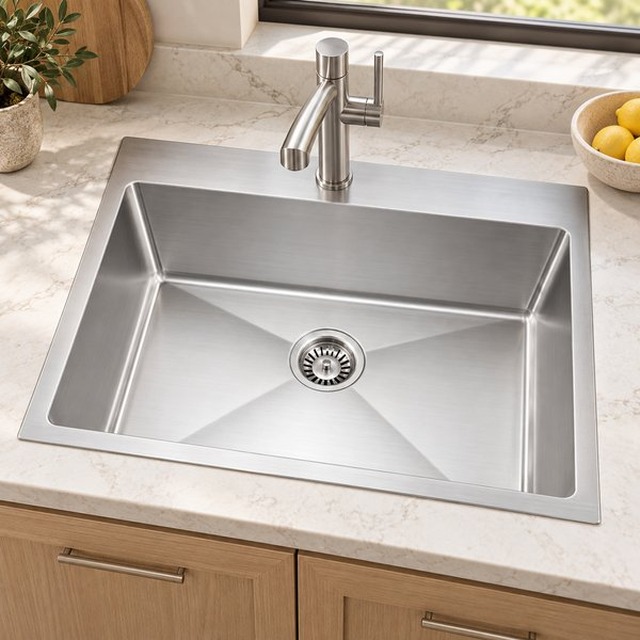
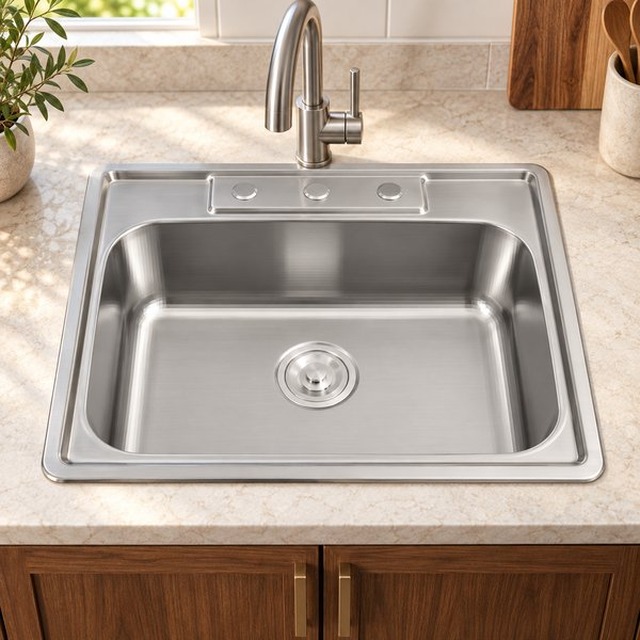
Take sinks as an example. A capable OEM should offer both handmade and pressed (punching) constructions, since these serve different price points and installation requirements. JOMOLA’s range illustrates this breadth: the Handmade Stainless Steel Sink 25″ x 22″ Undermount Single Bowl (model HTS2522-9) is built in durable 304 stainless steel with a brushed finish, while the Single Bowl Punching Stainless Steel Sink 25 × 22 in (model KA2522) offers a compact pressed layout for professional and residential applications. Buyers needing a combined unit can look at the Punching Stainless Steel Sink with Integrated Drainboard (model KA8543), which merges drainboard and sink body into one pressed unit. For larger B2B projects, the Handmade Stainless Steel Sink Double Bowl Undermount (model JSH-8245WB, 820×450×254mm) is crafted for demanding environments.
Faucets and drainage matter equally. The Zinc Alloy Pull Out Kitchen Faucet (model YF-05028-CP) combines a zinc alloy body, ceramic cartridge, and polished chrome finish for hot and cold water control, mounting via 3/8″ female compression fittings. On the drainage side, the Stainless Steel Floor Drain (model YYD-113) is made from 201 stainless steel at 0.8 mm thickness with a satin finish and is available in catalogue size series of 3, 3.5, 4, 5, and 6 inches. A partner with this kind of range can support a coordinated fixture programme rather than one-off orders.
Assess Process, Compliance, and Quality Control
Beyond the catalogue, examine how the manufacturer works. A structured OEM process typically begins with consultation on your design and specifications, followed by a technical and compliance review that checks production feasibility and standards while optimising cost and logistics. Tooling and material selection come next, with dedicated molds prepared for your programme. Ask prospective partners to walk you through each of these stages and to explain how they handle compliance for your destination market.
Quality control is where distant low-cost suppliers often fall short, and quality inconsistencies are a common concern among buyers. Request concrete evidence of process control—factory and production-line documentation, sample room access, and details of quality control procedures—rather than relying on brochures alone. Visual proof, such as video walkthroughs of production lines and finished products, gives buyers a more realistic picture of how a factory operates. Also confirm the cooperation models available. Leading manufacturers now offer several routes, including private label, ODM, OEM, custom development, and brand distribution, so you can choose the level of customisation that fits your business. Finally, discuss order flexibility: rigid minimum order quantities can be a barrier for buyers testing new markets, so clarify MOQ rules and scaling options early.
Match Sourcing to Market Trends
A reliable OEM partner should also help you read the market. The global kitchen sink market was valued at USD 3.8 billion in 2025 and is projected to reach USD 4.1 billion in 2026 and USD 7 billion by 2035, expanding at approximately 6.2% CAGR from 2026 to 2035, according to GMInsights. Grand View Research values the market at USD 3.9 billion in 2025, growing to USD 5.3 billion by 2033 at a 3.8% CAGR, with Asia Pacific holding a 47.1% revenue share in 2025. Residential replacement activity remains the largest volume base, while foodservice expansion and multifunctional workstation formats broaden value per installation. The low-price segment is also growing steadily in emerging economies, driven by residential construction and urbanisation.
These trends have practical sourcing implications. Buyers serving budget-conscious segments may prioritise pressed sinks, while premium channels can lean on handmade constructions. Design trends also matter: copper sinks are trending upward in 2026, particularly in farmhouse, rustic-modern, and luxury kitchens, and mixed metals are gaining attention. Discuss with your OEM how their tooling and material selection can accommodate such directions without compromising production feasibility.
Recent Company News
JOMOLA publishes buying guidance for trade buyers on its blog, including “Undermount vs Drop-In Sink: Which Fits Your Market?”, which frames the mounting-style decision around countertop systems and installation requirements rather than a universal winner; a “Stainless Steel Kitchen Sink Buying Guide for Wholesalers” covering gauge, finish, configuration, and supplier capability; a “Commercial Bathroom Fixture Maintenance Guide for B2B Buyers” noting that commercial fixtures must withstand 10–20x higher daily usage than residential ones; and a “Smart Kitchen & Bathroom Fixture Trends and IoT Integration: A B2B Sourcing Guide” on the category’s ongoing transformation. The company also highlights its Nano Black Hidden Sink OEM supply capability.
Conclusion
Choosing a reliable kitchen and bathroom fixtures OEM manufacturer comes down to three checks: whether the product range and construction methods fit your market, whether the factory follows a documented process with genuine quality control and flexible cooperation terms, and whether the partner can help you respond to market and design trends. Verify claims with factory evidence, confirm compliance and MOQ terms in writing, and start with sample orders before scaling. A manufacturer that supports you across sinks, faucets, and drainage—and communicates openly at every stage—is far more likely to become a long-term supply partner.
About JOMOLA
JOMOLA is a Chinese OEM/ODM manufacturer of kitchen sinks, kitchen faucets, bathroom sinks, bathroom faucets, shower faucets, and floor drains. Its product range includes handmade and punching stainless steel kitchen sinks, pull-out kitchen faucets with ceramic cartridges, and stainless steel floor drains in multiple catalogue sizes, serving professional, residential, and B2B buyers.
Sources
- https://www.gminsights.com/industry-analysis/kitchen-sinks-market
- https://www.grandviewresearch.com/industry-analysis/kitchen-sinks-market
- https://www.researchandmarkets.com/reports/6168826/kitchen-sink-market-opportunity-growth-drivers
- https://www.indexbox.io/blog/kitchen-sinks-market-to-2035-renovation-demand-and-design-upgrades-drive-forward-growth
- https://thesinkboutique.com/blogs/news/kitchen-design-trends-sinks-faucets
- https://marmoringroup.com/oem-bathroom-fixtures-and-kitchen-sinks
- https://marmoringroup.com
- https://www.yolec-electronics.com/how-to-choose-a-reliable-oem-small-kitchen-appliance-manufacturer-for-your-brand
- https://watersino.net