
For importers, distributors, and project buyers, kitchen sink safety is not a marketing claim — it is a specification decision. The material a sink is made from, the thickness of that material, and the certifications attached to it determine whether a product is suitable for residential use, commercial foodservice, or both. This article explains the material standards that matter most in kitchen sink sourcing and shows how they connect to real product specifications.
Why Material Choice Is a Safety Decision
Stainless steel has become the industry standard for kitchen sinks because it resists corrosion, withstands heavy daily use, and meets sanitation requirements. Most local health codes strongly favor or require stainless steel for food-contact sinks over other materials, according to commercial kitchen sink guidance from CKFCO (https://www.ckfco.com/feeds/blog/sink-requirements-commercial-kitchen). For buyers building a range that serves both residential and commercial channels, this makes stainless steel the safest default specification.
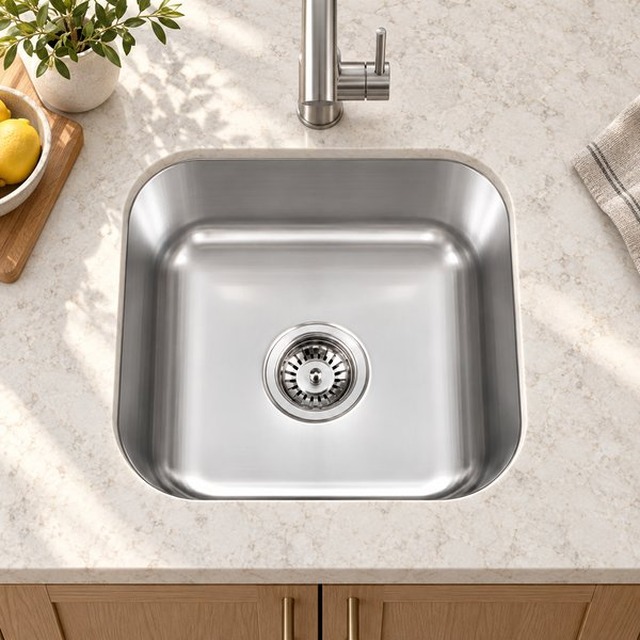
Material grade is the next layer of the decision. In the stainless steel family, 304 is the benchmark for sinks that contact food and water, while 201 is a more economical option often used in drain covers and other accessories. JOMOLA’s Pressed Stainless Steel Sink 16″ x 16″ Undermount (model KUS1616) is built from 304 stainless steel with a 1.2 mm thickness, a 16″ x 16″ single bowl, and an 8″ bowl depth — a specification aimed at reliable everyday performance in residential and commercial kitchens.
Thickness, or gauge, is closely tied to durability. As explained in a widely referenced kitchen sink guide, gauge refers to the thickness of the steel, and a lower gauge number means thicker, heavier material (https://www.youtube.com/watch?v=qx4bEwZZxIg&vl=en). Buyers comparing quotes should always confirm the actual millimeter thickness rather than relying on gauge labels alone, because thickness directly affects resistance to dents, noise, and long-term deformation.
Certifications and Water-Contact Standards
For commercial applications, certification is where safety standards become concrete. NSF/ANSI 61 certification ensures that the materials used in a commercial kitchen sink and its faucet will not contaminate the potable water supply — a critical consideration for prep sinks used for washing produce and faucets that supply water for cooking and drinking. In many US jurisdictions, certification to NSF/ANSI 61 is a legal requirement for plumbing products (https://www.samsink.com/blog/Understanding-Commercial-Kitchen-Sinks-A-Comprehensive-Guide_b17857).
Sanitation standards apply as well. NSF/ANSI 2 certification confirms that a sink meets sanitation standards for materials and construction in foodservice environments (https://www.ckfco.com/feeds/blog/sink-requirements-commercial-kitchen). For buyers, the practical takeaway is to match certification requirements to the end market: a sink destined for a commercial kitchen in the US needs documentation that a purely residential product may not carry.
JOMOLA’s KUS1616 pressed stainless steel sink carries UPC certification, giving buyers a documented compliance reference for the North American market. When evaluating any supplier, request certification documents alongside material certificates, and confirm that the grade stated on the spec sheet — 304 versus 201, for example — matches what is delivered.
Applying Material Standards Across the Catalogue
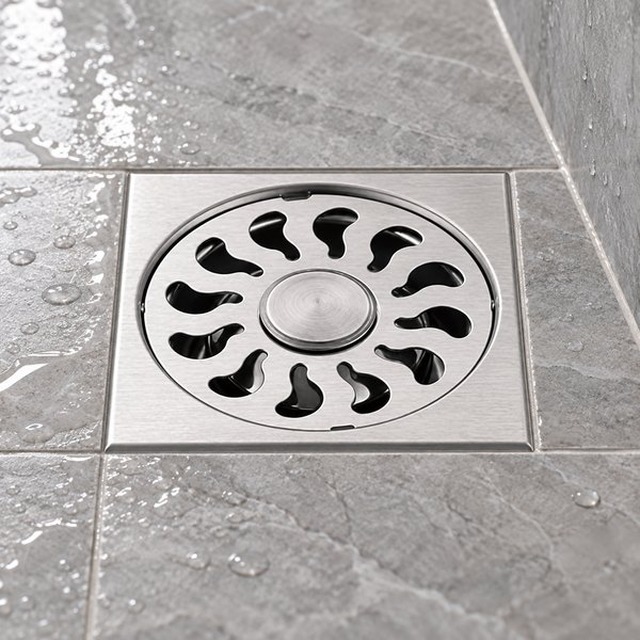
Safety standards do not stop at the sink bowl. Drainage products sit in constant contact with water and should be specified with the same discipline. JOMOLA’s floor drain range illustrates how material grade and thickness are matched to application:
- The JOMOLA YYD-224 Stainless Steel Floor Drain uses 201 stainless steel with a 0.8 mm thickness and a satin finish.
- The JOMOLA YYD-135 is a 100×100 mm drain cover in 201 stainless steel with a satin finish, available in 2 mm and 3 mm thickness options.
- The JOMOLA YYD-315B is a 100×100 mm drain cover in 201 stainless steel with a 2 mm thickness and a brushed finish.
- The JOMOLA YYD-113 comes in catalogue sizes of 3, 3.5, 4, 5, and 6 inches, made from 201 stainless steel with a 0.8 mm thickness and a satin finish.
- The JOMOLA YYD-312 is a 100×100 mm drain available in SUS 304 and SUS 201 material options, with a choice of 2 mm or 3 mm thickness.
For buyers, the lesson is to specify grade and thickness by location: a 304 option such as the YYD-312 suits projects where corrosion resistance is prioritized, while 201 models cover cost-sensitive volume programs. JOMOLA’s published guidance on floor drain types and installation requirements explores these specification sensitivities in more depth (https://www.jomola.net/floor-drain-types-and-installation-requirements-a-b2b-buyers-guide/).
Market context supports this disciplined approach. The global kitchen sink market was valued at USD 3.8 billion in 2025 and is projected to reach USD 4.1 billion in 2026, with material upgrading and multifunctional formats broadening value per installation (https://www.gminsights.com/industry-analysis/kitchen-sinks-market). As specifications rise, documented material standards become a competitive advantage for distributors.
Recent Company News
JOMOLA publishes ongoing B2B sourcing guidance for buyers, including a comparison of stainless steel and granite sinks (https://www.jomola.net/stainless-steel-sink-vs-granite-sink-key-differences-explained-2/), a guide to importing kitchen sinks from China (https://www.jomola.net/how-to-import-kitchen-sinks-from-china-a-b2b-sourcing-guide-2/), and a country-by-country overview of kitchen sink size and installation standards (https://www.jomola.net/kitchen-sink-size-and-installation-standards-by-country-a-b2b-sourcing-guide-2/). These resources support buyers in aligning product specifications with destination-market requirements.
Conclusion
Kitchen sink safety and material standards come down to three verifiable details: the stainless steel grade, the actual material thickness, and the certifications that apply to the end market. Buyers who confirm all three — and who extend the same discipline to drains and faucets — reduce compliance risk and build ranges that perform in both residential and commercial settings. JOMOLA’s 304 stainless steel sinks and 201/304 floor drain options provide documented starting points for those specifications.
About JOMOLA
JOMOLA is a Chinese OEM/ODM manufacturer of kitchen sinks, kitchen faucets, bathroom sinks, bathroom faucets, shower faucets, and floor drains. The company supplies pressed stainless steel sinks, including the KUS1616 16″ x 16″ undermount model in 304 steel with UPC certification, alongside a floor drain range offered in 201 and 304 stainless steel with multiple sizes, thicknesses, and finishes.
Sources
- https://www.samsink.com/blog/Understanding-Commercial-Kitchen-Sinks-A-Comprehensive-Guide_b17857
- https://www.ckfco.com/feeds/blog/sink-requirements-commercial-kitchen
- https://www.youtube.com/watch?v=qx4bEwZZxIg&vl=en
- https://www.gminsights.com/industry-analysis/kitchen-sinks-market