
For importers, distributors, and project buyers, kitchen sinks are not simply a design category — they are a safety and compliance category. A sink that looks correct in a catalogue can still fail inspection, void a warranty, or expose an end user to contaminated water if the material grade, thickness, and certification profile are wrong. This article explains the material and safety standards that matter when sourcing kitchen sinks, and how to read a supplier’s specifications with a critical eye.
Material Grades: What “Stainless Steel” Actually Means
Stainless steel dominates the kitchen sink category because it is durable, sanitary, easy to clean, and relatively inexpensive compared with alternative materials. However, “stainless steel” is a family of alloys, not a single specification. The two grades buyers encounter most often in sink and drain sourcing are SUS 304 and SUS 201.
SUS 304 is the benchmark for food-contact and wet-area applications. It offers strong corrosion resistance, which matters in kitchens where sinks are exposed to acids, salts, detergents, and constant moisture. SUS 201 is a lower-cost alternative that can be appropriate for certain drain covers and non-critical applications, but it is generally not the grade buyers should specify for primary food-prep surfaces.
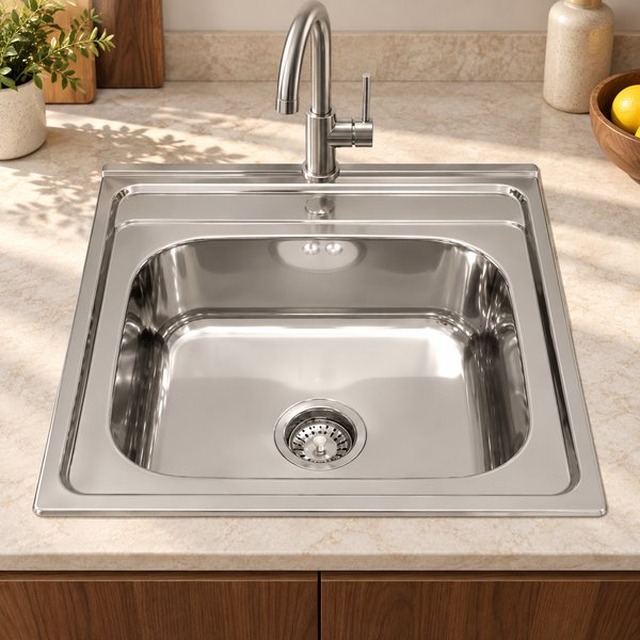
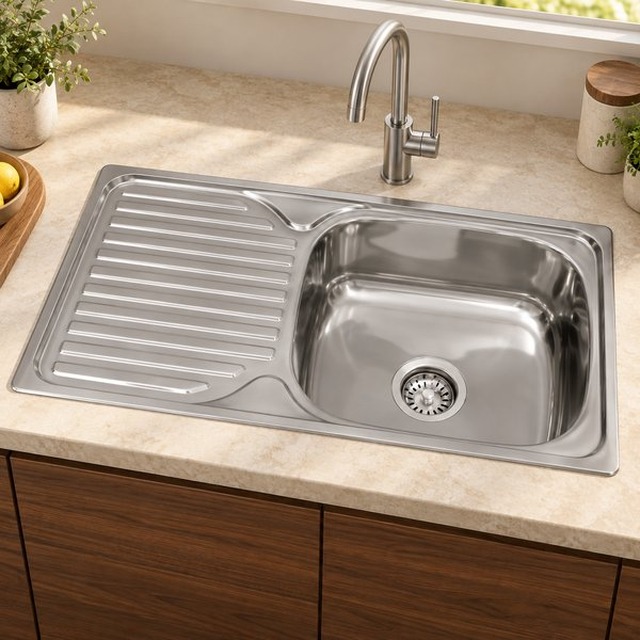
JOMOLA’s product range illustrates how grade selection maps to application. The JOMOLA Handmade Stainless Steel Sink 304 Brushed Double Bowl (36″ × 21″ × 10″, model FHD3621B) is built from 304 stainless steel with a brushed finish, with each bowl measuring 16″ × 16″ at a 10″ depth. The JOMOLA Punching Stainless Steel Sink Single Bowl 560x560mm (KA5656) and the JOMOLA Punching Stainless Steel Sink 860x430mm (KA8643, with integrated drainboard) are punched kitchen sinks formed through a punching process that shapes the bowl and deck from stainless sheet. On the drainage side, the JOMOLA Stainless Steel Floor Drain 200-1000mm Satin Finish (YYD-P9-D) and the YYD-飞边不锈钢平移 model are both manufactured from SUS 304 with 1 mm thickness and a satin finish, while the JOMOLA Stainless Steel Floor Drain 5/6 in Polished Finish (YYD-993-5) is offered in SUS 304 / 201 with 1.2 mm thickness.
The practical takeaway for buyers: confirm the alloy grade in writing, and match it to the end use. A 201 drain cover in a dry utility area is a different risk profile from a 201 basin in a commercial prep kitchen.
Thickness, Gauge, and Why They Drive Safety
Material grade is only half the specification. Thickness — expressed as gauge or millimetres — determines how a sink performs under load, heat, and daily impact. In the market, sink steel commonly ranges from roughly 16 gauge to 23 gauge, with 23 gauge being thin and 16 gauge being thicker; commercial sinks can sometimes be specified at 14 gauge. Thicker steel resists denting, warping, and the flexing that can stress weld points and drain connections over time.
Thickness also interacts with sanitation. High-volume commercial environments demand extreme durability and sanitation, and surface density matters heavily in those settings. A thin, flexing surface is harder to keep clean and more prone to damage that creates harbourage points for bacteria.
This is why buyers should treat thickness as a safety-adjacent specification, not a cost lever. JOMOLA publishes thickness figures directly in its drain specifications — 1 mm for the YYD-P9-D and YYD-飞边不锈钢平移 models, and 1.2 mm for the YYD-993-5 — which allows buyers to compare like for like across a range rather than relying on vague “heavy-duty” marketing language.
Certification and Regulatory Requirements
In regulated markets, material claims are not enough on their own. Certification is what converts a specification into an accepted installation.
For commercial kitchen sinks and their faucets, NSF/ANSI 61 certification addresses a specific and critical risk: ensuring the materials used will not contaminate the potable water supply. This matters most for prep sinks used to wash produce and for faucets supplying water for cooking and drinking. In many jurisdictions across the United States, certification to NSF/ANSI 61 is a legal requirement for plumbing products.
Separately, commercial stainless steel sinks must meet strict regulatory standards, and buyers should verify NSF/ANSI Standard 2 certification, which covers food safety and sanitation protocols. Health inspectors look for these stamps during routine checks — without them, a facility can fail inspection. In the United States, ANSI and NSF set the standards governing stainless steel sinks, and compliance is essential to ensuring safety, quality, and end-user health.
The sourcing implication is straightforward: for any project involving foodservice, healthcare, or other sensitive industries, certification status should be confirmed before purchase order, not after. Buyers should also note that certification applies to specific products and configurations, so a supplier’s general capability does not automatically extend to every SKU in a range.
Recent Company News
JOMOLA continues to publish B2B sourcing guidance across its core categories. Recent articles include “Floor Drain Types and Installation Requirements: A B2B Sourcing Guide,” “Shower Faucet Selection Guide for Bathroom Dealers,” “Stainless Steel Sink vs Granite Sink: Key Differences Explained,” and “How to Import Kitchen Sinks from China: A B2B Sourcing Guide.” The company also maintains a bathroom faucet OEM supplier page for buyers seeking OEM/ODM cooperation.
Conclusion
Kitchen sink safety comes down to three verifiable questions: what alloy is it, how thick is it, and what certifications does it carry? Buyers who insist on documented answers to all three protect themselves against inspection failures, premature product returns, and reputational damage in the projects they supply. Market context reinforces the stakes — the global kitchen sink market was valued at USD 3.8 billion in 2025 and is projected to reach USD 4.1 billion in 2026, expanding at approximately 6.2% CAGR to USD 7 billion by 2035, with material upgrading among the forces broadening value per installation. As specification levels rise, so does the cost of sourcing on price alone.
About JOMOLA
JOMOLA is a Chinese OEM/ODM manufacturer of kitchen sinks, kitchen faucets, bathroom sinks, bathroom faucets, shower faucets, and floor drains. The company’s catalogue includes punching sinks, handmade stainless steel sinks, and SUS 304 stainless steel floor drains in satin and polished finishes, serving importers, distributors, wholesalers, and project buyers.
Sources
- https://www.samsink.com/blog/Understanding-Commercial-Kitchen-Sinks-A-Comprehensive-Guide_b17857
- https://www.liangshunkitchensink.com/Kitchen-Sink-Materials-Practical-Guide-to-Choosing-Your-Next-Sink-id06550825.html
- https://theportablesink.com/kitchen-sink-materials
- https://www.chicadragon.com/understanding-industry-regulations-and-certifications-for-stainless-steel-sinks
- https://www.youtube.com/watch?v=m87Eb0t6VbY
- https://www.gminsights.com/industry-analysis/kitchen-sinks-market