
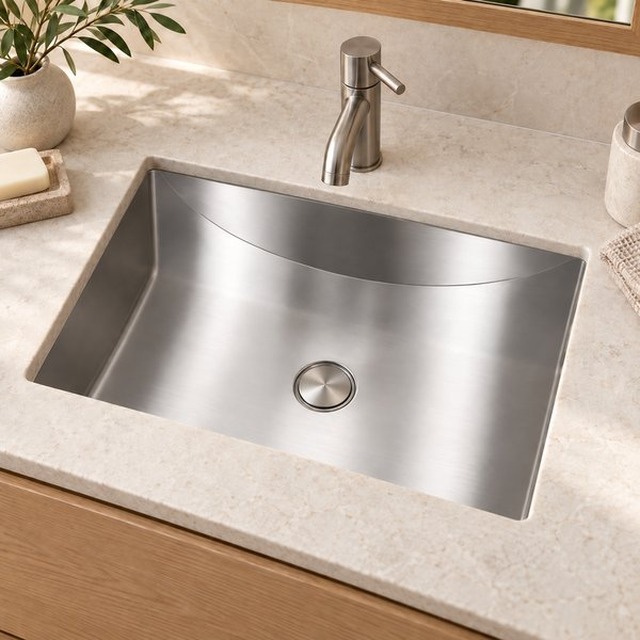
For importers, distributors, and project buyers, understanding how an OEM kitchen sink is actually made is essential to evaluating supplier capability, quality consistency, and lead times. The process differs significantly between drawn (pressed) sinks and handmade sinks, and each stage carries implications for tooling investment, minimum order quantities, and final product performance. This guide walks through the main steps, using JOMOLA’s real product lines as reference points.
Stage 1: Blanking, Drawing, and Forming
The manufacturing process begins with raw material selection. Stainless steel sheets are the starting point for kitchen sink production, and the sheet thickness must be calculated against the finished sink dimensions before any cutting takes place. According to TECOOL’s published process description, a sheet cutter is used to cut the stainless steel plate to the required size, with a typical sheet thickness range of 0.8–1.0 mm for drawn sinks — beyond this range, even a 500T hydraulic press becomes ineffective.
For drawn or punched sinks, the cut blank then goes through deep drawing, blanking, and trimming stages, with specific machines assigned to each step. JOMOLA’s punching sink range reflects this production route: the KA12060 double bowl punching stainless steel sink (1200 x 600 mm) and the KA3838 single bowl punching sink (380 x 380 mm) are both produced through precision punching and pressing processes to the design shown in the catalogue. The KA15050E punching sink with integrated drainboard follows the same punched construction logic, giving distributors and project specifiers a repeatable, catalogue-matched product.
Handmade sinks take a different path. Rather than being drawn from a single sheet, they are handcrafted — which is why JOMOLA’s handmade range can offer specific bowl geometry and thickness options. The BHUS2115 handmade stainless steel sink, for example, is built from 304 stainless steel with a brushed finish, measuring 21″ × 15″ × 6 1/4″ overall with a 19″ × 13″ bowl and 6 1/4″ bowl depth, and a 1.0–1.5 mm thickness. The JSH-7545WT-G handmade topmount sink (750 × 450 × 230 mm) is likewise a handcrafted stainless steel sink with a brushed surface treatment, supplied with a strainer with pipe.
Stage 2: Surface Treatment and Finishing
After forming, sinks move into surface treatment. Industry process documentation describes several finishing routes: scrub (brushing), sandblasting (electrolysis), polishing (mirror), and embossing. Grinding is typically divided into three or four sections depending on the differences between the basin and the equipment being used.
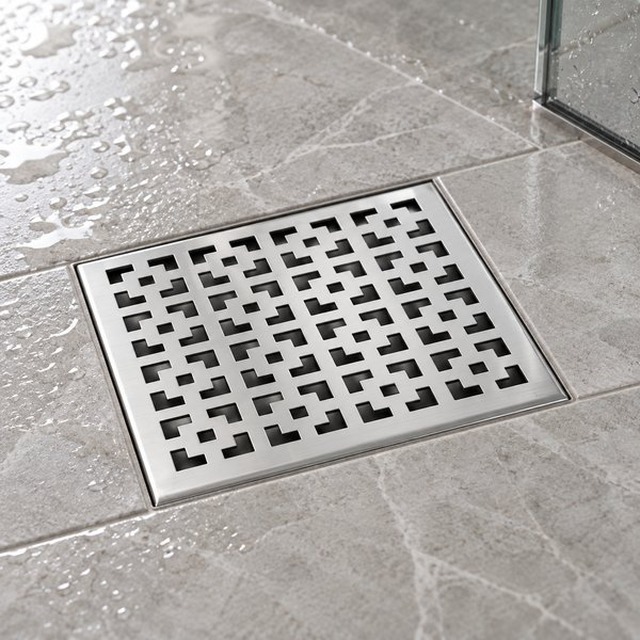
Brushed finishes remain the most common specification for B2B kitchen sink programs, and JOMOLA applies this finish across multiple product families — the BHUS2115 and JSH-7545WT-G handmade sinks both carry a brushed finish. The same finishing discipline extends to other categories in the JOMOLA range: the YYD-P30-30 stainless steel floor drain is built from SUS 304 material with a 1.7 mm thickness and a satin finish, a durable drain cover for residential and commercial wet areas.
Depending on buyer requirements, additional reinforcement steps may be applied. Glue-reinforced ribs or hooks are sometimes used, and automated production lines increasingly handle tasks such as silicone application and final assembly of drain components and accessories — a development that improves efficiency and consistency at volume.
Stage 3: Assembly, Accessories, and Quality Control
The final production stage covers accessory fitting and inspection. Sinks are completed with drain assemblies, strainers, and mounting hardware as specified in the order. JOMOLA’s JSH-7545WT-G, for instance, includes a strainer with pipe as part of its standard configuration.
For OEM/ODM buyers, this stage is also where customization decisions are locked in. Handmade production is particularly suited to high-end customized products — irregular sinks or integrated kitchen countertops — and can support small batch orders, with some manufacturers citing minimum order quantities as low as 5 pieces for this route. That flexibility matters in a market where the global kitchen sink market was valued at USD 3.8 billion in 2025 and is projected to reach USD 4.1 billion in 2026, expanding at approximately 6.2% CAGR from 2026 to 2035, with residential replacement activity forming the largest volume base.
Compliance is a parallel consideration throughout production. JOMOLA’s published guidance notes that kitchen sinks are not simply a design category but a safety and compliance category — a sink that looks correct in a catalogue can still fail inspection. Buyers sourcing for the EU should also review water efficiency requirements for faucets, which have moved from a niche sustainability concern to a core compliance and procurement issue.
Recent Company News
JOMOLA maintains an active technical content program for B2B buyers. Recent published guides include “Water Efficiency Requirements for Faucets in the EU: A B2B Sourcing Guide,” “Kitchen Sink Safety and Material Standards Explained,” “Floor Drain Types and Installation Requirements: A B2B Sourcing Guide,” and the “Shower Faucet Selection Guide for Bathroom Dealers.” The company also publishes a bathroom faucet OEM supplier page covering its OEM/ODM capabilities.
Conclusion
OEM kitchen sink manufacturing is a multi-stage process: material selection and blanking, forming via deep drawing or handcrafting, surface treatment, and final assembly with accessories. Drawn and punched sinks suit high-volume, catalogue-standard programs, while handmade construction supports customization and smaller batches. For buyers, the practical takeaway is to match the production route to the order profile — and to verify material grade, thickness, and finish at the specification stage rather than after inspection.
About JOMOLA
JOMOLA is a Chinese OEM/ODM manufacturer of kitchen sinks, kitchen faucets, bathroom sinks, bathroom faucets, shower faucets, and floor drains. Its product range includes handmade stainless steel sinks, punching stainless steel sinks, and stainless steel floor drains, serving importers, distributors, and project buyers.
Sources
- https://www.scribd.com/presentation/431360338/Manufacturing-of-steel-sinks
- https://www.tecoolsink.com/news/manufacturing-process-of-stainless-steel-drawn-sinks
- https://www.samsink.com/comm06/Stainless-Steel-Sink-Manufacturing-Process.htm
- https://www.youtube.com/watch?v=hYjw1EMnSTM
- https://www.harsle.com/stainless-steel-sink-manufacturing
- https://www.gminsights.com/industry-analysis/kitchen-sinks-market
- https://www.jomola.net/water-efficiency-requirements-for-faucets-in-the-eu-a-b2b-sourcing-guide/
- https://www.jomola.net/kitchen-sink-safety-and-material-standards-explained/
- https://www.jomola.net/floor-drain-types-and-installation-requirements-a-b2b-sourcing-guide/
- https://www.jomola.net/shower-faucet-selection-guide-for-bathroom-dealers/
- https://www.jomola.net/bathroom-faucet-oem-supplier-jomola-2/