
The kitchen and bathroom categories are no longer defined solely by finish, form, or durability. Across residential and commercial projects, buyers are increasingly evaluating fixtures as part of a connected environment — one in which appliances, lighting, and water-delivery products communicate with each other and with the people who use them. For importers, distributors, and project buyers, understanding how IoT integration is reshaping demand is now part of sourcing strategy, not a future consideration.
The Shift Toward Connected Kitchen Environments
Market research on built-in kitchen appliances in the United Kingdom highlights how smart technology is changing the way consumers think about the kitchen. Smart ovens can preheat according to a scheduled mealtime, recommend cooking modes based on a recipe, and notify users when a meal is ready. Smart dishwashers can detect soiling levels and adjust water usage to optimize efficiency. Critically, this trend is described not merely as a convenience story but as part of a broader shift toward energy efficiency, customization, and modern living.
That shift has direct implications for the fixture layer of the kitchen. Manufacturers of kitchen appliances have recognized the potential of IoT and are investing in infrastructure that allows products to communicate with one another — a feature valued by consumers who already use connected devices. As the kitchen becomes a network of cooperating products, the sink and faucet are no longer isolated components. They sit at the center of the workflow that connected appliances are designed to support.
For B2B buyers, this means the specification conversation is widening. A distributor sourcing a pull-out kitchen faucet or a double bowl sink is increasingly asked how those products fit into a coordinated, technology-enabled kitchen. The answer is not always about adding electronics to the fixture itself. More often, it is about choosing durable, well-engineered products that perform reliably within a smart ecosystem — and about working with a manufacturer that can support private label and OEM programs as the category evolves.
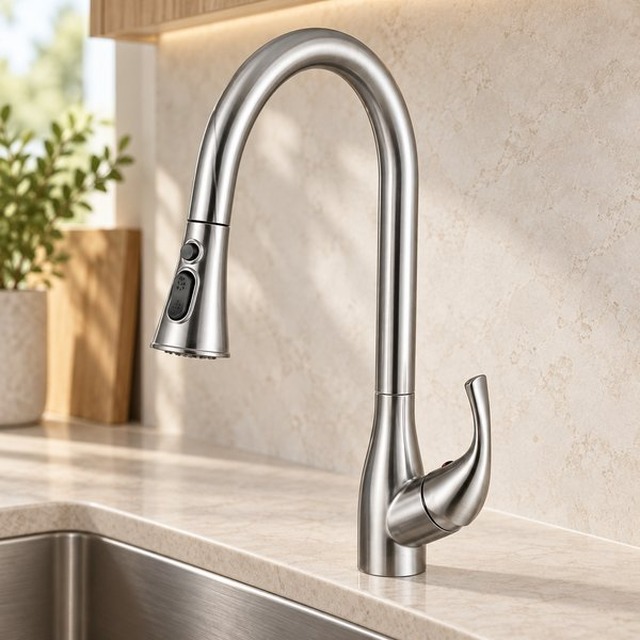
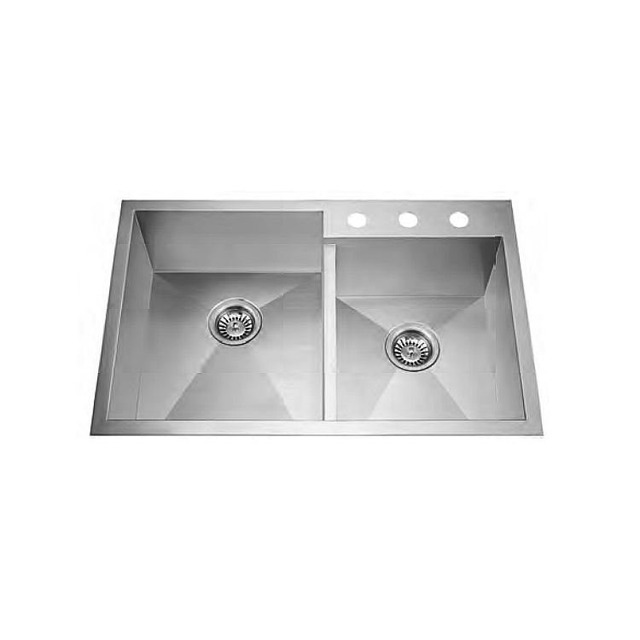
JOMOLA’s kitchen portfolio reflects this practical, specification-led approach. The JOMOLA F500 SUS 304 stainless steel kitchen faucet, with a 416 mm overall height and 195.8 mm spout height, is a pull-out kitchen faucet built from SUS 304 stainless steel with a satin finish for demanding B2B kitchen environments. On the sink side, the JOMOLA topmount stainless steel double bowl kitchen sink (model JDH-8456-1) offers an 838 × 558 × 228 mm (33″ × 22″ × 9″) configuration with a brushed satin finish, while the KA2522 punching stainless steel sink provides a compact 25 × 22 in single bowl layout. For larger workflows, the KA10046A punching stainless steel sink measures 1000 × 460 mm and includes an integrated drainboard. These are the kinds of core products that anchor a kitchen specification, regardless of how much connectivity is layered on top.
Bathroom Automation and Hygiene-Driven Demand
The bathroom is following a similar trajectory, though with different drivers. Industry analysis of smart bathroom technology trends points to AI and IoT integration as among the biggest smart home developments, with benefits extending to mental health, overall well-being, and additional customization choices. Smart toilets are frequently cited as a leading example of the category.
Academic review work on IoT systems in interior design and the built environment adds useful context. Research indicates that introducing IoT systems into bathrooms can improve hygiene and user experience by automating certain functions. Work on hygiene in communal toilets supports this, showing that IoT can increase public awareness of proper hygiene and promote adoption of smarter technologies. The same review notes that IoT systems can enhance kitchen safety — reinforcing that the connected-home trend spans both rooms rather than residing in one.
For buyers, the practical takeaway is that bathroom fixtures are being evaluated on more than appearance. Drainage performance, material consistency, and installation compatibility matter more than ever, because a smart bathroom still depends on physical infrastructure that works. JOMOLA’s floor drain range addresses this foundation. The YYD-104 stainless steel floor drain is manufactured from 201 stainless steel with 0.8 mm thickness and a satin finish, available in Series 3, 3.5, 4, 5, and 6 inch catalogue sizes. The YYD-弹跳地漏 pop-up floor drain is also constructed from 201 stainless steel, offered in 3.5, 4, and 5 inch catalogue sizes with a choice of 1.5 mm or 2 mm thickness. These are the components that keep a technology-enabled bathroom functional behind the scenes.
What This Means for Sourcing and Specification
The connected-fixture trend is real, but it does not replace the fundamentals that B2B buyers are judged on: material standards, compliance, and manufacturing consistency. JOMOLA’s published guidance for buyers reflects this. The company’s blog covers water efficiency requirements for faucets in the EU as a compliance and procurement issue, kitchen sink safety and material standards, floor drain types and installation requirements, the OEM kitchen sink manufacturing process step by step, and private label faucet branding for B2B buyers. Each of these topics sits upstream of any smart feature — because a connected product that fails inspection or underperforms in the field is a liability, not an innovation.
Broader market data supports the scale of the opportunity. The global kitchen sink market was valued at USD 3.8 billion in 2025 and is projected to reach USD 4.1 billion in 2026 and USD 7 billion by 2035, expanding at approximately 6.2% CAGR from 2026 to 2035, according to GM Insights. Residential replacement activity remains the largest volume base, while foodservice expansion, material upgrading, and multifunctional workstation formats broaden the value captured per installation. A separate forecast from Research and Markets describes the household kitchen sink market as a USD 12.5 billion prospect by 2034. These figures suggest that even as IoT reshapes the premium end of the category, volume demand for well-made core fixtures continues to grow.
Design trends reinforce the same conclusion. Analysis of 2026 kitchen design trends identifies mixed metals and coordinated finishes as a leading direction, with designers intentionally pairing complementary metals across sinks, faucets, cabinet hardware, and accessories rather than matching every finish exactly. For manufacturers, that means finish consistency across a product family — satin, brushed satin, and polished options — becomes a competitive advantage. JOMOLA’s range spans these finishes across kitchen faucets, kitchen sinks, and floor drains, allowing buyers to build coordinated programs under a single private label.
Recent Company News
JOMOLA’s recent published content for B2B audiences includes a private label faucet branding guide for B2B buyers, an OEM kitchen sink manufacturing process walkthrough, a B2B sourcing guide on EU water efficiency requirements for faucets, an explainer on kitchen sink safety and material standards, and a B2B sourcing guide on floor drain types and installation requirements. These resources are aimed at importers, distributors, and project buyers evaluating supplier capability, quality consistency, and lead times.
Conclusion
IoT integration is changing what buyers expect from kitchen and bathroom fixtures, but it is not changing the fundamentals. Connected appliances and automated bathroom functions depend on durable, compliant, well-manufactured hardware underneath. For importers and distributors, the winning strategy is to pair a credible private label and OEM partner with a product range that covers both the visible specification — finish, size, configuration — and the invisible one: material grade, thickness, and installation compatibility. JOMOLA’s SUS 304 kitchen faucets, stainless steel kitchen sinks, and 201 stainless steel floor drains are built for that dual requirement.
About JOMOLA
JOMOLA is a Chinese OEM/ODM manufacturer of kitchen sinks, kitchen faucets, bathroom sinks, bathroom faucets, shower faucets, and floor drains. The company supplies importers, distributors, and project buyers with private label and OEM programs across stainless steel kitchen faucets, handmade and punching kitchen sinks, and stainless steel floor drains in multiple catalogue sizes and finishes.
Sources
- https://finance.yahoo.com/news/united-kingdom-2-24-bn-161500669.html
- https://www.hippo.com/blog/smart-bathroom-technology
- https://finance.yahoo.com/news/smart-kitchen-appliances-market-size-121400294.html
- https://pmc.ncbi.nlm.nih.gov/articles/PMC10716557
- https://thesinkboutique.com/blogs/news/kitchen-design-trends-sinks-faucets
- https://www.gminsights.com/industry-analysis/kitchen-sinks-market
- https://finance.yahoo.com/news/household-kitchen-sinks-market-forecast-164100288.html